Tag: aviation

  • The Importance of Flexibility: Why Family Matters at Ascends Solutions

    The Importance of Flexibility: Why Family Matters at Ascends Solutions

    In the fast-paced world of consulting, the balance between work and family life can often feel elusive. Deadlines, client demands, and the drive to excel can sometimes make it seem like work must always come first. However, at Ascend Solutions, we believe that true success comes when family is prioritized. This isn’t just a slogan—it’s the foundation of how we operate and a key reason why our team thrives.

    All of our consultants come from large corporate environments, where the pressure to perform is high and the work-life balance is often challenging. Now that they are part of our team, they enjoy a different kind of culture—one where flexibility, autonomy, and intrinsic motivation are not just encouraged, but essential.

    We believe that flexibility isn’t about working less—it’s about working smarter. Our consultants are experts in their fields, passionate about their work, and fully committed to delivering outstanding results for our clients. But we also understand that life happens outside of work. Whether it’s picking up kids from school, attending a family event, or just taking the time to be present for loved ones, we trust our team to manage their schedules in a way that allows them to excel both professionally and personally.

    Why does family matter so much to us? The answer is simple: family is a source of motivation, support, and purpose. When our consultants feel secure in their ability to care for their families, they bring that same care and dedication to their work. They are more engaged, more focused, and more creative because they know they have the freedom to balance their personal and professional lives.

    We’re proud that Ascend Solutions is a place where people can do meaningful work without sacrificing time with their families. For us, it’s not just about creating a family-friendly environment—it’s about recognizing that when people feel valued and supported at home, they can bring their best selves to everything they do.

    We don’t believe in micromanaging. Our team members are trusted professionals who have already proven themselves in demanding corporate roles. We empower them to take ownership of their work, manage their time, and deliver results in a way that suits them best. This level of autonomy fosters a sense of ownership and accountability, driving high performance without the need for rigid oversight.

    Autonomy doesn’t just benefit the individual; it benefits our clients, too. When consultants are free to work in a way that aligns with their personal rhythms and priorities, they’re able to bring their full expertise and passion to each project. It’s a win-win for everyone involved.

    In today’s world, achieving a balance between work and family is more important than ever. At Ascend Solutions, we’re committed to creating a culture where family truly comes first, and flexibility is not a perk but a fundamental value. Our consultants are proof that when people are given the freedom to prioritize their families and work autonomously, they not only deliver exceptional results—they live more fulfilling lives.

    We believe this approach isn’t just the future of work—it’s the right way to work–and it’s our way to work!

    If you’d like to learn more about Ascend Solutions and how our company culture and expertise can help you then please get in touch below.

    This blog was written by Marion Blanz, Managing Director at Ascend Solutions.

  • What is a Digital Capability Assessment? 

    What is a Digital Capability Assessment? 

    In the rapidly evolving Aviation industry, staying competitive requires more than just maintaining aircraft and operations—it involves embracing digital solutions that improve efficiency, safety, and decision-making. One of the most critical steps to achieving this is through a Digital Capability Assessment. This structured evaluation helps aviation companies understand their current digital landscape and uncovers opportunities for improvement and innovation.

    A Digital Capability Assessment is a comprehensive review of an organisation’s digital resources, processes, and strategies. In Aviation, where operations are increasingly data-driven, this assessment is vital for identifying how well-equipped a company is to leverage digital technologies for everything from  fleet management to predictive maintenance. 

    The assessment focuses on four key areas:

    1. Business Assessment

    The first step is understanding the organisation’s value-driven challenges—the key issues that, if solved, will have the greatest impact. For example, an airline or airframe manufacturer might be looking to reduce operational delays, improve maintenance processes, or optimise fuel consumption. This phase examines the company’s strategy, growth plans, KPIs, and costs to ensure that the assessment aligns with the business’s overall vision and goals.

    2. Process Mapping  

    In Aviation, where systems are interconnected across safety, maintenance, operations, and customer service, understanding the workflow is essential. Process mapping provides a clear view of how different functions work together, such as how maintenance teams communicate with flight operations or how data flows between various departments. This step helps assessors identify inefficiencies and opportunities for digital solutions.

    3. Data Mapping

    A Digital Capability Assessment evaluates the accessibility, type, format, sources, and velocity of data being used across the organisation. The objective is to identify the information (data), data sources and data accuracy used during an activity. Whether it’s real-time sensor data from aircraft, maintenance logs, or customer feedback, this step ensures that the business has a clear understanding of how data is managed and how it could be better utilised to improve the performance and efficiency of the maintenance services while significantly reducing costs.

    4. Digital Capability Evaluation

    This phase focuses on assessing the company’s current systems, tools, skills, and resources. Do you have the right technology stack in place? Are the teams equipped with the necessary digital skills? For Aviation companies, this could include assessing how effectively AI-driven systems are used for tasks like predictive maintenance, flight scheduling, or passenger experience optimisation. By understanding the digital resources available, the assessment highlights where improvements or investments are needed.

    The Aviation industry faces unique challenges—complex regulations, safety concerns, and high operational costs. Yet, many aviation companies struggle to articulate their digital challenges in a way that leads to actionable solutions. This is often because they don’t fully understand the “art of the possible” with digital technologies.

    This assessment allows experienced data professionals to ask the right questions, uncover underlying issues, and offer practical, data-driven recommendations. A Digital Capability Assessment is not just about identifying problems—it’s about revealing the untapped potential of digital transformation and ensuring that the solutions are tailored to the unique needs of the aviation company.

    At Ascend Solutions, we take a collaborative approach to conducting Digital Capability Assessments, working closely with Aviation clients to understand their business inside and out. The process typically involves a series of workshops and interviews, ideally conducted on-site. We create a safe, open environment where teams can discuss their challenges honestly.

    Aviation professionals are encouraged to share data samples, whether they are digital logs, paper forms, or other documents, and even demonstrate their day-to-day activities. This hands-on approach allows us to gain a deep understanding of the business, which enables us to provide targeted recommendations. We also use tools like process mapping and Root Cause Analysis (such as the 5 Whys technique) to dig deeper into the core challenges.

    The assessments can be conducted at any time irrespective of an organisation’s digital maturity. However, they are particularly effective as part of an existing transformation or when the organisation is experiencing significant difficulty. The common thread is an environment where data driven decision making is likely to be the most impactful.

    By assessing the current digital landscape, businesses can avoid costly mistakes and prioritise initiatives that will provide the greatest value. For example, an airline considering a new fleet management system would benefit from an assessment to ensure that not only does the system fit seamlessly with their current operations but has the potential to provide data and insights that may benefit other parts of the business..

    At Ascend Solutions, we bring a unique blend of Aviation expertise and deep knowledge of data-driven solutions. Our team understands the intricacies of Aviation operations, from fleet management to predictive maintenance, and has a proven track record of delivering actionable insights and successful digital transformations. For example in 2024, we worked with a North American airframer to implement AI-powered predictive maintenance solutions, showcasing our ability to bring cutting-edge technology into real-world aviation operations.

    Our Digital Capability Assessment helps you navigate the complexities of your operations, ensuring that you have a clear path to digital maturity. We look at your available data, assess your systems, and identify any constraints such as IT capabilities or compliance requirements. By understanding your business’s digital strengths and weaknesses, we can guide you toward the most valuable and viable solutions.

    If your aviation business is ready to unlock the full potential of digital transformation, a Digital Capability Assessment is the first step. At Ascend Solutions, we have the industry expertise and data-driven approach to help you navigate the complexities of digital innovation and achieve lasting success. Let us help you identify the opportunities that will elevate your operations and keep you ahead in the competitive aviation industry.

    Reach out to Ascend Solutions today, and let’s explore how we can help your business soar.

  • The challenges of GenAI in the Aviation Industry

    The challenges of GenAI in the Aviation Industry

    Generative Artificial Intelligence (GenAI) is revolutionising the way we interact with technology, offering powerful tools to generate everything from text to images with just a simple prompt. GenAI is built on Large Language Models (LLMs), which are trained on massive amounts of data to predict sentences, paragraphs, or even whole documents. These models can produce human-like responses across a wide range of topics. However, when it comes to complex, highly specialised fields like Aviation, GenAI faces unique challenges.

    Large Language Models (LLMs) like those used in services like ChatGPT are designed to predict the next word in a sentence based on an input sentence or request called a “prompt”. They have been trained on huge datasets, which allows them to “understand” and respond to various subjects. By processing this data, LLMs can generate meaningful text, making them useful for tasks like drafting emails, summarising documents, or answering customer queries. They can even mimic different writing styles, which is why they’re called “Generative” AI.

    Despite their impressive capabilities, LLMs have limitations, especially when applied to industries like aviation.

    GenAI is particularly good at handling tasks like:

    Generating content: Text generation, summarisation, and writing assistance for general topics.

    Customer service: Answering common questions in natural language, making it easier for customers to interact with businesses.

    Automation: Streamlining repetitive tasks like data entry or report generation.

    For industries like social media or marketing, where the language is common and straightforward, GenAI excels. But what about sectors like aviation, where the language is more technical and precise?

    One of the significant drawbacks of GenAI is that it struggles with specialised language. Aviation, engineering, and technical fields have their own jargon, acronyms, and terminology that aren’t as well-represented in the data these models are trained on.

    For example, if you ask an LLM to generate content about the latest social media trends, it will do so effortlessly, drawing from the vast amount of training data on that topic. However, if you ask it to explain the intricacies of aircraft maintenance or part numbers, it may struggle. This happens because aviation terms and part numbers are rare in the training data compared to everyday language.

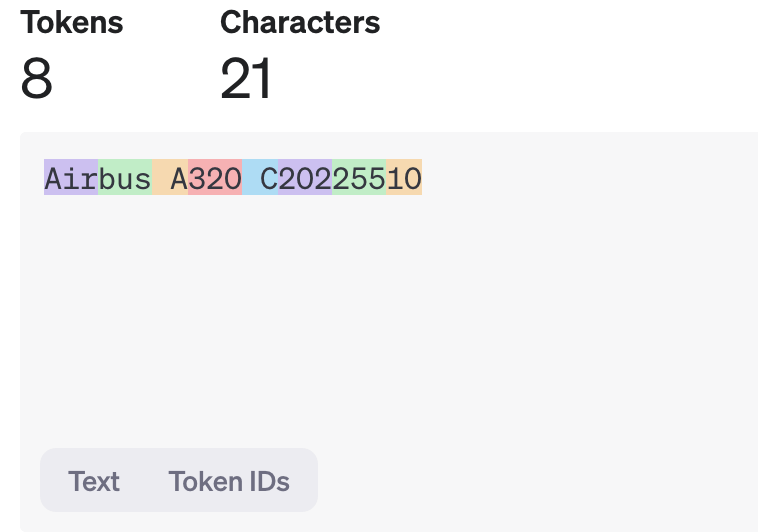
    LLMs use tokens to process and generate text. Tokens are small units of meaning, often individual words or parts of words. When dealing with highly technical fields like aviation, the number of tokens required increases dramatically. For instance, aviation terms can cost 4-6 times as much in tokens compared to common social media terms, and part numbers can cost up to 10 times as much.

    To illustrate this, tools like OpenAI’s Tokenizer can show how GenAI “sees” language. When you enter common words, the token count is low, making the process efficient. But when you enter technical aviation terms, the token count rises significantly, making it more costly and less efficient for these models to generate accurate and detailed responses.

    OpenAI’s Tokenizer – token count for Taylor Swift
    OpenAI’s Tokenizer – token count for Airbus A320 (Safran) brake unit part number

    LLMs have several limitations when applied to the aviation industry:

    Lack of industry-specific knowledge: LLMs aren’t as familiar with aviation terminology or technical engineering language, leading to inaccurate or incomplete responses.

    Token cost inefficiency: More tokens are required to understand and generate text for aviation-related content, making it costly and less efficient.

    Explainability issues: In a highly regulated industry like aviation, transparency and verification are essential. GenAI models often operate as black boxes, making it difficult to explain their decisions—an issue that is unacceptable in safety-critical sectors.

    At Ascend Solutions, we understand both the potential and the limitations of Generative AI in the aviation industry. We have deep experience in both fields, which gives us the unique ability to tailor GenAI applications to meet the specific needs of aviation. Here’s how we do it:

    – Pre-processing and Post-processing: We don’t just rely on raw GenAI outputs. By carefully preparing the input data (pre-processing) and refining the output (post-processing), we ensure that the information generated by LLMs meets the high standards required in aviation. This includes filtering for accuracy, ensuring proper terminology, and reducing token inefficiency.

    – Pipeline Optimisation: We build robust data pipelines that integrate GenAI with other tools, allowing for seamless, accurate, and cost-efficient processes. Our pipelines are designed to handle specialised language, and we implement additional steps to verify the outputs, ensuring they are both reliable and explainable.

    – Expert Knowledge: Our team comprises both aviation veterans and machine learning specialists. This means we can bridge the gap between cutting-edge AI technology and the rigorous demands of the aviation industry. We know where GenAI can add value and where it falls short, and we have the expertise to make up for these gaps.

    Generative AI and Large Language Models have incredible potential, but applying them to aviation comes with its own set of challenges. While LLMs are great for generating everyday content, their lack of familiarity with technical aviation terms and their inefficiency in processing specialised language mean they can’t be used out-of-the-box in this industry.

    At Ascend Solutions, we have the experience and knowledge to overcome these obstacles. By optimising data pipelines, ensuring accuracy, and leveraging our dual expertise in aviation and AI, we help businesses harness the power of GenAI while meeting the strict standards of safety and reliability required in aviation.

    Let us help you unlock the potential of GenAI for your aviation needs—safely, efficiently, and effectively. Get in touch for more information

  • Artificial Intelligence vs. Machine Learning

    Artificial Intelligence vs. Machine Learning

    Artificial Intelligence (AI) and Machine Learning (ML) are terms that often get thrown around, but they’re not the same thing. Understanding their differences and how they work together is key to making the most out of them—especially when you’re dealing with highly regulated fields like Aviation, where precision, explainability, and safety are paramount.

    Artificial Intelligence (AI) is the bigger picture. AI refers to the development of systems that can reason, learn, and act like humans. The goal is to create machines that can think and make decisions autonomously, using logic, patterns, and past data to guide them. A good way to think about AI is that it tries to mimic human intelligence in machines. 

    AI is everywhere—whether it’s your phone assistant (think Siri or Google Assistant), facial recognition on your phone, or those semi-autonomous driving cars on the road. 

    Machine Learning (ML) is a part of AI, and it’s all about learning from data and capturing that in a model. ML is focused on teaching computers to make decisions based on patterns they find in data—without someone needing to program every rule. For example, instead of telling a program how to recognize a dog in an image, you feed it thousands of pictures of dogs, and the ML training algorithm figures out what features make something look like a dog.

    This ability to identify patterns has made ML models incredibly useful for tasks like predicting insurance quotes, detecting fraud, and improving customer service.

    Here’s where it gets interesting:

    Tree and Linear Models in ML help make decisions that are easy to understand. For instance, these models are great for things like calculating home or car insurance rates.

    Deep Learning Models takes this a step further, mimicking the human brain with layers of processing called “neurons.” This allows computers to recognize images, understand speech, and even make sense of handwritten letters. Think about Ring doorbell cameras recognising faces or your phone’s handwriting recognition.

    Deep Learning powers some of the coolest technology today, like computer vision (used in semi-autonomous cars) and natural language processing (used in voice assistants like Alexa).

    Generative AI is a type of ML that can create new content from patterns it has learned. Think of tools like ChatGPT or image generators. These systems don’t just repeat what they’ve learned; they generate new content like text, images, or even music based on the patterns they’ve been trained on.

    However, while generative AI is incredibly powerful, it’s important to understand that it’s not perfect. It can generate realistic-sounding text or images, but it doesn’t “understand” the information the way humans do. This is why ‘explainability’ becomes such a big issue, especially in critical industries like Aviation.

    In sectors like Aviation, you can’t just take the outputs of Machine Learning models at face value. The Aviation industry is highly regulated and safety-critical, meaning every decision needs to be explainable and verifiable. The risk is too high to rely on systems that “just work” without understanding how or why they’re making decisions.

    This is where many ML engineers, while experts in their field, may fall short. They may know the latest techniques but lack the ability to explain the reasoning behind the models in a way that meets strict industry standards. Aviation requires models that can provide transparent reasoning, not just black-box answers.

    At Ascend Solutions, our team has years of experience and understanding in both Aviation and Machine Learning. This unique blend means we don’t just understand the technology—we also know how to apply it in a way that meets the high expectations of regulated industries like Aviation.

    We help businesses harness the power of AI and ML while ensuring every output is explainable, verifiable, and, most importantly, safe. Whether it’s improving data analytics or integrating machine learning into operational processes, we ensure that our solutions don’t just meet technical standards—they meet the strict safety standards necessary in Aviation.

    Our team has the experience to bridge the gap between cutting-edge technology and the practical, real-world needs of the aviation sector. We use Machine Learning to extract insights from data, helping businesses operate more efficiently while always prioritising safety and compliance.

    In summary, AI and ML are transforming industries across the board, but using these technologies safely and effectively requires expertise—especially in regulated fields. At Ascend Solutions we combine our deep understanding of both Aviation and Machine Learning to deliver solutions that are not only innovative but also meet the highest standards of safety and reliability. 

    Let us help you soar into the future of AI with confidence. Get in touch with the team today

  • Embracing the Digital Revolution in Aerospace:

    Embracing the Digital Revolution in Aerospace:

    How Ascend Solutions Enhances Data Analysis for Beautech 

    In the rapidly evolving aerospace industry, the ability to leverage data effectively is crucial for staying competitive. Companies that embrace the digital revolution are not only able to streamline their operations but also enhance their decision-making processes. At Ascend Solutions we have always believed in harnessing the power of data to help organisations achieve their goals.  

    Ascend Solutions: Pioneering Data-Driven Solutions

    We know that the future of the aerospace industry lies in fully embracing the digital landscape. The vast amounts of data generated by aviation activities can be overwhelming, but with the right tools and expertise, this data becomes a valuable asset. Ascend Solutions is dedicated to helping aerospace companies navigate this data landscape, enabling them to make informed decisions that drive efficiency and innovation.

    Take our recent project with BeauTech Power Systems (Europe), a leading engine leasing company. BeauTech Power Systems (Europe) sought our expertise to explore how Large Language Models (LLMs) could be used to improve the accuracy and efficiency of comparing Engine Parts Lists—an essential, time-consuming and challenging task in their operations.

    The Challenge: Ensuring Accuracy in Engine Parts Lists

    Engine Parts Lists are critical documents in the aviation industry, detailing the components and specifications of aircraft engines. In addition, due to the shortage of new aircraft deliveries, leases are often extended. These lists are at high risk of errors, such as alternate, incorrect, or missing parts, which can lead to significant operational and safety issues. Traditionally, the comparison of these documents has been labour-intensive and a time-consuming process, requiring meticulous manual scrutiny.

    BeauTech Power Systems (Europe) approached Ascend Solutions with a clear objective: to verify whether LLMs could automate the comparison of these lists, reducing the manual labour involved and increasing accuracy. Our team was excited to take on this challenge and showcase the potential of advanced data technologies in solving real-world problems.

    The Solution: Leveraging Large Language Models (LLMs)

    We started with an in-depth exploration of Beautech’s needs and the specific challenges they faced with their Engine Parts Lists. We then demonstrated how LLMs could be trained and utilised to compare documents, identify discrepancies, and highlight potential issues. The goal was to create a more automated, reliable, and efficient process that would save time and reduce the risk of errors.

    BeauTech Power Systems’ (Europe) testimonial speaks volumes about the success of this project:

    “We engaged Ascend Solutions to verify that Large Language Models (LLMs) are capable of identifying differences between two sets of Engine Parts Lists that are typically at high risk of having alternate, incorrect or missing parts. A more automated process has the potential to significantly reduce the manual labour needed. We are pleased with the outcome of this presentation. The format, messaging, and understanding of LLMs demonstrated by the team exceeded our expectations.”

    The Impact: A Positive Collaboration Experience

    The project with BeauTech Power Systems (Europe) not only demonstrated the technical capabilities of LLMs but also highlighted the importance of clear communication and understanding. Our team worked diligently to ensure that BeauTech Power Systems (Europe) fully grasped the potential benefits and applications of LLMs in their operations. This transparent and informative approach was greatly appreciated:

    “The team’s clear and well-presented explanation of how the tool works and its purpose made it straightforward for us to grasp its potential benefits. We appreciated their efforts in ensuring that we understood what LLMs are capable of and how they can be leveraged effectively.”

    BeauTech Power Systems’ (Europe) positive experience underscores the value that Ascend Solutions brings to the table, providing not just technical expertise but also a deep understanding of client needs and how to meet them.

    Conclusion: The Need for Data-Driven Partners

    In an industry as complex and data-rich as aerospace, companies must partner with experts who can help decipher and leverage data effectively. Plus they must also have an in-depth knowledge of aviation processes and procedures. Ascend Solutions is proud to work with progressive organisations such as BeauTech Power Systems (Europe), offering innovative solutions that not only meet current needs but also pave the way for future advancements.

    As the aerospace industry continues to evolve, the role of data will only become more critical. Companies that embrace digital tools and data-driven decision-making will be better positioned to navigate challenges and seize opportunities. Ascend Solutions stands ready to assist in this journey, helping organisations unlock the full potential of their data to achieve their goals.

    Want to learn more? Get in touch with the team below

  • The Importance of Standards and Maintenance for Everyone

    The Importance of Standards and Maintenance for Everyone

    In our very complex world of aviation, the key importance of standards and maintenance cannot be overstated. However it is true to say that many operators and Maintenance, Repair & Overhaul (MRO) organisations are often not fully aware of all the standards or the principles behind them. It is not overstating to say the understanding and the significance of the standards is vital to ensure safety, efficiency and reliability in Aviation. In this blog we outline the basics of standards and maintenance and then explore what all MROs should be implementing in their organisation today. 

    The Evolution of Maintenance Standards: From MSG-1 to MSG-3

    Let’s start from the beginning – the Maintenance Steering Group (MSG) has played a pivotal role in shaping aviation maintenance standards over the decades.  The journey began with MSG-1, a simplistic approach primarily based on the Boeing 747. Although groundbreaking at the time, MSG-1 did not account for aircraft that weren’t in active use. Therefore this initial framework laid the foundations but was clearly limited in scope and application.

    MSG-2: Introduction of Condition-Based Concepts

    MSG-2 introduced the idea of “condition,” which was a significant evolution from MSG-1. This version, although based on studies of various American aircraft, highlighted a critical insight: too much maintenance could be detrimental. Over-maintenance opened up more opportunities for human error, thus compromising safety. MSG-2 brought forth the idea that maintenance should be based on the actual condition of components rather than rigid schedules.

    MSG-3: A More Comprehensive Approach

    MSG-3, is the current standard and has addressed the ambiguities left by its predecessors. It introduced several novel concepts and offered a more structured and detailed framework for maintenance programs. Most importantly, MSG-3 included elements of Structural Health Monitoring (SHM), this leverages sensors to monitor the health of an aircraft in real-time. However despite these advancements, many in the industry remain stuck on older versions of the standards, missing out on the significant benefits available to them of a more data-driven approach.

    The Benefits of Condition-Based Maintenance

    Condition-Based Maintenance (CBM) represents the future of aviation maintenance. By utilising real-time data and advanced monitoring technologies, CBM allows for maintenance activities to be performed only when necessary (by condition or life-limit). This approach not only enhances safety but also reduces costs and downtime. Skywise is one example of how CBM can be implemented successfully, Aviatar is another, both demonstrate the substantial benefits of being more data-driven.

    Why Standards and Maintenance Matter for Everyone

    It is important to understand that standards and maintenance protocols are not just for large airlines or aircraft manufacturers; they are applicable to everyone in the aviation industry. Whether you are an operator, MRO, or even a small charter service, adhering to these standards means::

    Safety: Consistent and thorough maintenance practices prevent accidents and incidents.

    Efficiency: Proper maintenance minimises downtime and operational disruptions.

    Cost-effectiveness: Avoiding unnecessary maintenance tasks reduces costs while ensuring the aircraft is in optimal condition.

    Regulatory Compliance: Meeting international standards is essential for operating in various regions and under different regulatory bodies.

    So why is Ascend Solutions the Ideal Partner?

    It can be very challenging to follow the complexity of aviation maintenance standards. Ascend Solutions provide you with the expertise, enabling you to apply the latest digital discoveries to your organisation’s objectives. This includes:

    Expertise: A deep knowledge of the evolution and principles behind MSG standards.

    Innovation: We can apply the latest technologies, including SHM and CBM, to ensure your maintenance practices are cutting-edge.

    Customisation: We provide bespoke, tailored solutions to fit the unique needs of your operation, ensuring compliance and efficiency.

    Support: We offer ongoing support and guidance to keep your maintenance practices up to date and effective long term. 

    Choosing Ascend Solutions means partnering with a company that understands the importance of standards and maintenance for everyone in the aviation industry. We focus on safety, efficiency, and reliability ensuring your organisation’s individual needs are always met.

    If you’d like to speak to one of the team to learn more then please contact us below

  • What is Condition Monitoring?

    What is Condition Monitoring?

    Condition Monitoring in Aviation is a vital part of any efficient airline. To put it simply, Condition Monitoring is the continuous and/or periodic assessment of any aircraft’s systems or components. This is to ensure that they operate within guidelines and to detect any signs of wear, failure or degradation before there are any significant problems. Condition Monitoring is there to make sure the high safety standards are maintained. It can also optimise maintenance schedules, reduce downtime and enhance the overall operational efficiency. 

    What are the key elements of Condition Monitoring?

    Data Collection 

    Sensors – There are numerous sensors that monitor engine performance, hydraulic pressure, temperature, vibration and structural integrity. 

    Data Acquisition Systems 

    These systems collect data from the sensors and prepare it for analysis. This includes the Aircraft Condition Monitoring System (ACMS) and Quick Access Recorders (QAR).

    Data Transmission 

    This makes sure the data can be transmitted in real-time to ground stations via systems like the Aircraft Communications Addressing and Reporting System (ACARS). Wireless data transfer systems are used to upload data when the aircraft is on the ground at airports.

    Data Analysis

    The key component to successful Condition Monitoring – there are different ways to analyse this data – including:

    Real-Time Monitoring: Some systems provide real-time data analysis and alert the flight crew or ground maintenance teams of any issues

    Post-Flight Analysis: Data is downloaded and analysed after flights to identify trends and potential problems.

    Predictive Analytics: Advanced algorithms and machine learning models are used to predict potential failures before they occur, allowing for proactive maintenance.

    Maintenance Actions

    Following the analysis of all the data there are various steps that can be taken:

    Preventive Maintenance: Based on the analysis, maintenance can be scheduled to address potential issues before they lead to failure.

    Corrective Maintenance: If an issue is detected or been reported through another channel, immediate actions can be taken to rectify the problem.

    Predictive Maintenance: This uses data trends and predictive models to foresee potential failures and address them preemptively.

    What are the benefits of Condition Monitoring?

    Clearly and most importantly Condition Monitoring is necessary to ensure the increased safety of the aircraft. Any issues should be detected early which reduces the risk of in-flight failures. But also key is that by spotting these issues before they are problems means that airlines can avoid expensive repairs and minimise downtime. Plus airlines may also avoid the cost of more expensive parts or labour to replace a bigger problem. 

    Identifying issues earlier means the aircraft is kept in a better condition which means reliability is improved, delays are reduced and the overall fleet availability is greater and much more efficient. Spending less time on the ground undergoing unscheduled maintenance not improves fleet availability but is also significantly cheaper by avoiding the high costs of parts and facilities on short notice as well as minimising passenger disruption.

    Implementing Condition Monitoring

    There are several things to consider when implementing Condition Monitoring. Firstly the integration of the aircraft systems with condition monitoring systems – this needs to be done rigorously to assure success. Airlines also need to consider the ground infrastructure to ensure they are able to receive, process and analyse data transmitted from the aircraft. Finally Condition Monitoring practices must comply with aviation safety regulations and standards set by authorities like the Federal Aviation Administration (FAA) and the European Union Aviation Safety Agency (EASA).

    Ascend Solutions: Revolutionising Condition Monitoring for Airlines

    In the competitive and safety-critical world of aviation, Condition Monitoring is no longer optional; it’s essential. Ascend Solutions is unique in having experts in both Aviation and Data Practices that can provide the tools and expertise airlines need to implement effective Condition Monitoring, ensuring safety, efficiency, and reliability. By leveraging advanced data collection, real-time analysis, and predictive maintenance, Ascend Solutions is helping airlines navigate the skies with confidence and precision.

    For more information on how Ascend Solutions can transform your airline’s Condition Monitoring practices contact our team of experts today. Fly smarter, safer, and more efficiently with Ascend Solutions.

  • Sustainability in Aviation – Navigating a new approach.

    Sustainability in Aviation – Navigating a new approach.

    One of the burning questions facing aviation in recent years has been not just ensuring sustainability in the Aviation sector but more vitally how Airlines can understand and master the evolving technologies developed to address these challenges. Ascend Solutions had the good fortune to attend the RAeS Transport Specialist Group conference at Cranfield University recently. The keynote speech from Swaran Sidhu, Head of Fleet Technical Services at easyJet provided a compelling overview of the technology evolution through the eyes of an Airline. 

    This really inspired the Ascend Solutions team to consider some of the key takeaways from the conference and consider how we can work with airlines to help them navigate these challenges. So let’s take a look at some of the key issues we think all airlines need to consider. 

    One of the significant challenges highlighted is the necessity for airlines to operate aircraft much longer than initially anticipated. Due to delivery delays from major manufacturers like Airbus and Boeing, airlines that previously managed fleets with an average age of three years are now operating aircraft that are seven years old. This shift requires a re-evaluation of maintenance and operational strategies to ensure efficiency and safety over extended periods.

    EasyJet’s ambition to become the most data-driven airline was a central theme in Sidhu’s keynote. This mirrors a broader industry trend towards converting paper documents to a digital equivalent (e.g. PDFs), a theme also echoed by Virgin Atlantic during the conference.

    Digital transformation, particularly in maintenance operations, is a key factor. The evolution of Maintenance Philosophy, from (Maintenance Standards Group) MSG-1 to MSG-4, underscores the importance of continuous improvement in maintenance strategies. Airlines now emphasise Hard Time, On-Condition, and Condition Monitoring approaches to enhance efficiency and safety. At the core of these digital services for easyJet is Airbus Skywise, a robust platform for data-driven decision-making.

    In this rapidly evolving landscape, Ascend Solutions is uniquely positioned to assist airlines in addressing these challenges through a suite of innovative solutions:

    1. Extending Asset Life: Ascend Solutions can help you decipher and implement advanced predictive maintenance tools that utilise data analytics to monitor and react to your assets health. From the whole aircraft, to engines, major subsystems such as the undercarriage to customer facing systems such as the In Flight Entertainment (IFE). This proactive approach helps airlines maintain older fleets more effectively, reducing downtime and unexpected failures.

    2. Unlock Digitalisation: We enable airlines to take advantage of paper-based processes converted to digital formats seamlessly. By leveraging AI and Machine Learning, we help streamline document management, reducing reliance on paper and enhancing operational efficiency.

    3. Data-Driven Maintenance Strategies: With an expert team experienced in implementing platforms like Airbus Skywise, Ascend Solutions supports airlines in adopting data-driven maintenance strategies. Our solutions facilitate the transition from traditional maintenance practices to more advanced, condition-based monitoring, ensuring optimal performance and safety.

    4. Continuous Improvement and Compliance: Understanding the complexities of evolving maintenance requirements, Ascend Solutions walks you through and provides the tools to ensure compliance with the latest MSG standards. Our solutions help airlines navigate the transition from MSG-1 through MSG-4, fostering a culture of continuous improvement.

    As highlighted in a recent LinkedIn post, Ascend Solutions is committed to supporting airlines in their digital transformation journey. Our collaboration with industry leaders ensures that our solutions are tailored to meet the specific needs of each airline, driving efficiency and sustainability.

    The RAeS Conference on the Sustainable Hangar of the Future underscored the critical need for innovation and adaptability in the airline industry. As airlines face prolonged aircraft lifespans and strive for digitalisation, Ascend Solutions is ready to guide them on their journey. By providing cutting-edge solutions in predictive maintenance, digital transformation, and data-driven decision-making, we empower airlines to achieve their goals of efficiency, safety, and sustainability.

    For more information on how Ascend Solutions can help you navigate these challenges, get in touch or connect with us on LinkedIn.